Producers Blog
Why You Should Manage Excess Corn Residue
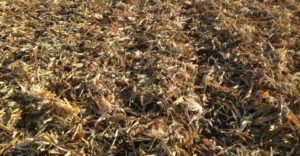
As planting season closes in on us, it is important to look at ways that crop residue can affect your current year’s corn crop. The past few years, growers have made significant progress in overall yields. Whether through hybrid selection, better fertility programs or higher populations, growers have seen yields continue to surpass historical production. Just as grain yields have increased, so have the amounts of residue or stover. These residue increases may also be attributed to the increased use of fungicides, Bt traits and the use of no-till practices – all of which reduce the rate of decomposition and increase the overall amount of residue within a field.
Benefits and challenges of residue
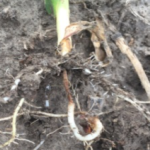 Residue and conservation tillage has numerous benefits including:
- Cropland erosion control
- Increased soil permeability
- Moisture conservation
- Reduced compaction
- More biological activity
- Overall soil health
However, excess residue can pose a number of challenges for growers – especially in a corn-on-corn situation.
- Excess residue can reflect sunlight and insulate the soil, which keeps the soil more cool and wet during planting. This can lead to variety of issues including:
- Germination issues
- More prevalent seedling diseases
- Inadequate seed depth
- Poor soil-to-seed contact
- Germination issues
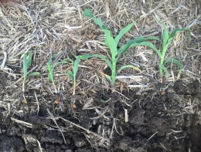
All of which lead to a non-uniform emergence!
This is important because non-uniform or late-emerging plants rarely reach full yield potential and often compete with healthy plants for nutrients, resulting in lower yields. These issues can be magnified as growers continually try to push their planting dates earlier and earlier.
How – and when – to manage excess residue
First is at harvest. It is important that the combine is adjusted to the proper settings. Also check that the chaff and stalk distribution behind the combine is spread in a uniform manner. This becomes more difficult as the size of your combine head increases. Some combine heads allow for additional options for chopping chaff and stalks, which allow for smaller pieces that ultimately break down faster. All of these recommendations can help with decomposition – plus, you have less plugging issues with seeding and tillage equipment later on.
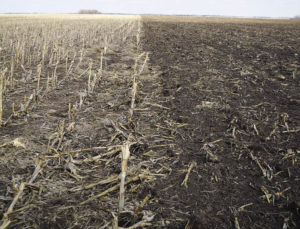
Next is tillage during the fall and spring. There are a number of tillage practices: conventional disks, deep chisel, mulch rippers, etc.
- Vertical tillage is a method that doesn’t necessary incorporate the residue into the soil but it reduces the size of the residue by using narrowly spaced rippled coulters to cut stalks and root balls into smaller pieces at high speeds.
- Another method is strip tillage, which is a combination of no-till and conventional tillage. It is a narrow band of approximately 7” that has characteristics of conventional tillage (loose granulized soil), while the remaining 23” of row area is undisturbed. Also during strip-till, fertilizer is usually applied in the narrow band just under the seed location, allowing for additional nutrients and warmer soils in the spring. Any tillage that i
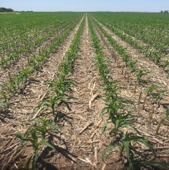 ncorporates the residue into the soil will increase decomposition rates.
 - Fall tillage allows for more time and therefore will break down residue at a higher rate than spring tillage. Some growers that have cattle will graze or bale stalks to manage residue. In these situations, complete stover removal is not recommended. Remember that the stover contains nutrients that normally would mineralize during a growing season, so an additional fertilizer might be needed to replace that stover if removed completely.
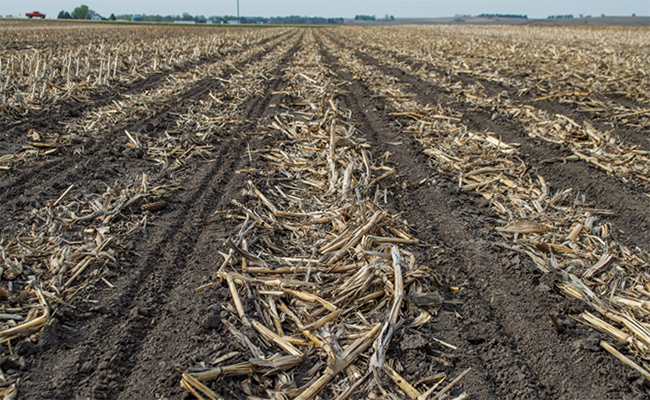
The last opportunity to manage excess residue is during planting. By using planter-mounted devices such as coulters, clearing discs, sweeps, brushes and rolling fingers, growers can remove residue to clear a 10” path in front of the planting units. Again, it is important to check for the proper settings because every field can be different. Before you start planting, use this checklist to check disc angles, height, down pressure and more, which all play a role in accurate crop removal. This serves to minimize the detrimental effects of residue in the row area while maintaining the benefits of residue on the remainder of the field.
Excess residue can create a number of production issues – the biggest one being a non-uniform stand. With appropriate management, a grower can have the benefits of residue and also have a uniform plant stand that will give the crop a great start and an opportunity to reach its full potential at the end of the growing season.
If you’d like to discuss this topic more, contact your dealer or District Sales Manager to get in touch with a Sales Agronomist in your area.
Agronomy | Performance | Soil | Yields