Producers Blog
Visiting Producers Hybrids Country :: South Dakota
This week I had the opportunity to travel to South Dakota. Having never been farther than Sioux Falls, I was seeing the state with fresh eyes and a fresh perspective. I went in expecting to see a flat, rural state without much to offer. While I definitely saw my fair share of flat land and rural areas, I believe that the unique landscapes and rural lands of South Dakota offer their own sense of calmness and community.
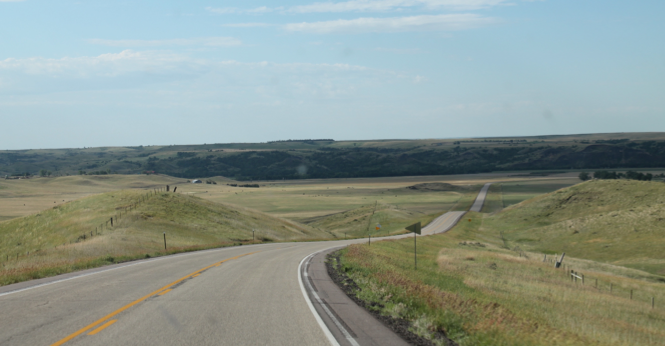 When people say they live in rural South Dakota, they mean rural. I’m not talking a town every half hour type of rural, I’m talking you might not see another gas station for three hours so you better fill up now, type of rural. I actually counted, and on the hour and a half drive out to a farm, I saw more people on 4-wheelers and in pastures than we did in cars. I come from a rural farm town, but this was a whole new level and I was loving it. The countryside was so peaceful and beautiful, I completely understood why people would build their house an hour and a half from a town just to be there.
The towns weren’t only rural though, they were old-school. Tyler, one of the South Dakota sales interns, and I were on our way to deliver the seed we had picked up that morning. Throughout the day, I kept noticing unique looking signs on some corners off the highway. The signs had a name and then gave directions to their house. For example, one post might say “Smith – 3N, .5W” implying that the Smith farm was three miles north and a half mile west of there. I hadn’t seen anything like this before, and quite frankly it seemed a little old fashioned. People could just use their GPS, right? Wrong. Shortly after we turned onto the road, my phone was flashing “No Service” at the top and the GPS was gone.
This event was a nice reminder that sometimes the old-school way is the best way. There’s no need to get wrapped up with bells and whistles when you have a perfectly good sign at the end of the road telling you where to go. Sometimes it’s better to just sit back, follow the signs, and enjoy the views. And when it comes to those views, South Dakota has some of the best.
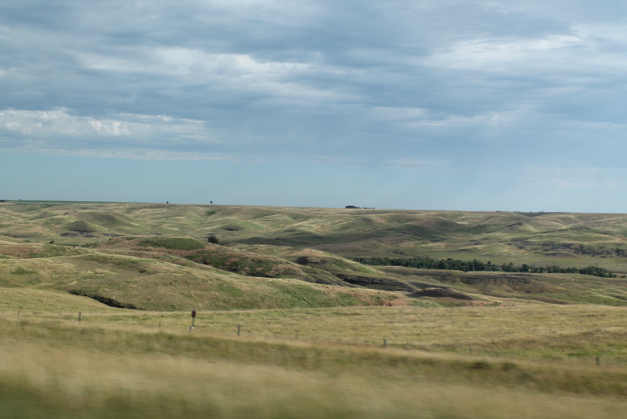 Bradyn, another South Dakota sales intern, had warned me that the landscape would change quickly, but I wasn’t expecting it to change quite as fast as it did. We were driving through flat prairie land and I reached into my bag to get the camera ready for the day. By the time I looked up, I swear we had gone into a different state. The land had changed from flat crop land to rolling hills and pasture in, almost literally, the blink of an eye. I loved this landscape, and I was much more excited about my trip through South Dakota after seeing it.
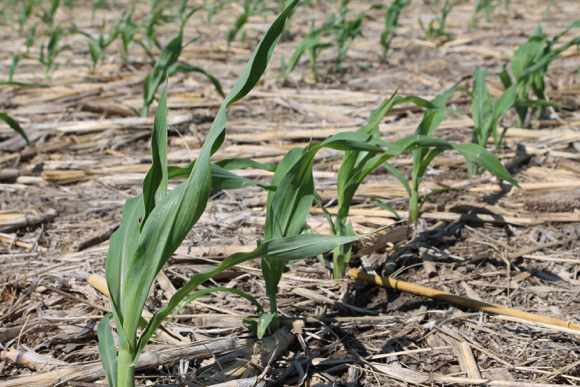
Bradyn and I put on many miles that day, driving from field to field taking soil samples and stand counts. I was intrigued, as I always seem to be, by the planting strategies of this state. South Dakota’s soil is dryer than some, and when taking stand counts I was surprised to get counts that were much less than what we would see in Iowa or Nebraska. This was another realization that spoke to the amount of education and hard work that goes into farming. Farming is not a uniform concept and if you grow corn in South Dakota with the same strategies as you use in Iowa, the results would be staggeringly different.
Each farmer has to know his or her land and has to know what is the best use of the land. In Iowa, maybe the best use is to grow soybeans. In Kansas, maybe the best use is to double-crop wheat and corn. In South Dakota, maybe the best use is to grow alfalfa. It’s all about perspective and knowing how to work with what you have.
 I truly loved South Dakota. I loved the unique rural aspect of the state that was unlike any other I had visited, I loved the landscape and the views and I loved the farmers who seemed to be bound together by the rural state that they lived and worked in. And of course, I loved being able to (legally) drive 80 miles per hour on the interstate. It is safe to say that I will return to South Dakota in the future, but for now stay tuned for my trip to Minnesota next week!