Producers Blog
Tips for Corn Irrigation Scheduling
Typically, every year near the 1st of July, the irrigation season kicks into full gear across the Western Corn Belt. Knowing when to irrigate corn is a science of its own that takes years to fully understand. Every year presents new challenges with weather patterns that make it even more difficult to master. However, knowing when and how to water can save a farmer money in the long run. Could you save a pass? Will not watering cost you yield?
Crop Water Use
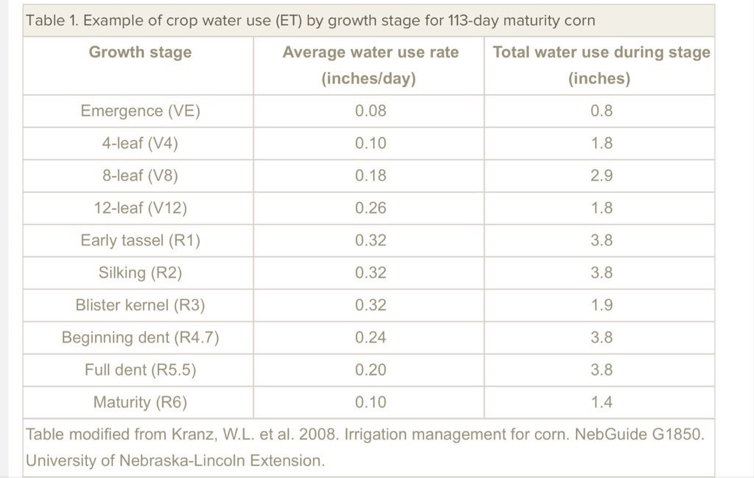
Every crop uses water a little differently. In general, peak water use occurs from the beginning of flowering through grain development. The chart below shows an average use for a corn crop. Evapotranspiration, or ET, is affected by humidity and temperature so it will fluctuate by the current weather patterns. For up-to-date weekly ET uses, visit UNL CropWatch.
Irrigation Scheduling Tools
A crop consultant is a great asset when it comes to irrigation scheduling, but not all operations use consultants. Also, a typical consultant is only at each field once a week; if they visit the field on a Monday and it rains Thursday, it would be up to the farmer to adjust accordingly. The hand feel method of scheduling is the cheapest way of figuring out how much moisture is currently available for the crop. The only tool needed for this is a three-foot soil probe. The chart below explains the hand method by soil type at a glance.
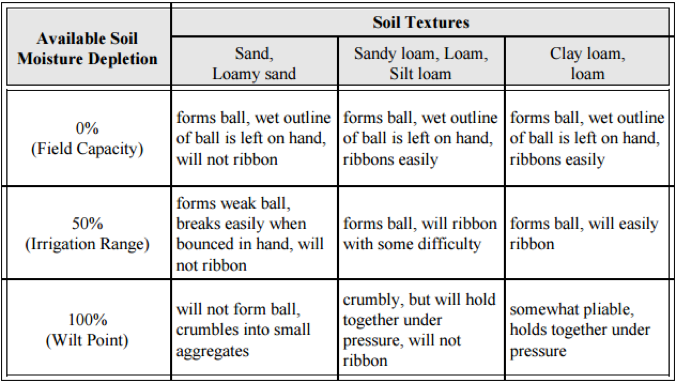
Source: Irrigation Scheduling with the Feel Method by Craig A. Storlie, Ph.D., Extension Specialist in Agricultural Engineering
It is important to understand how deep your plants are rooted, as well. A plant at V5 is likely only rooted into the top 18 inches or so while a tasseled plant should be rooted down three feet. When using the hand feel method, it’s important to only factor in the soil in the rootzone.
In the last few years, soil moisture probes have become much more popular. These systems range in complexity from simple Watermark sensors that are small gypsum blocks to the more complex capacitance probes that can have a number of sensors at varying depths. The great part of these is once they are installed the user can use a website to check the current moisture level of each field. The drawback is these probes are one small part of the field and shouldn’t be used as a stand-alone system for management decisions.
Properly managing irrigation is best done by being hands on. Seeing a plant leaf rolling from the road and using this as the decision to turn on the pivot is not enough. Every hybrid handles stress differently and some will leaf roll anytime the temperature gets over 90 degrees while some never will. Using either the hand feel method or a moisture probe to determine the amount of moisture in the profile is the only true way to tell whether the crop requires irrigation. As with most aspects of crop management, the best way to make decision is to get a little dirt on your boots and find out for yourself what is happening in your fields. If you’d like someone to come walk your fields with you, give your Producers Hybrids District Sales Manager or Sales Agronomist a call. We’d be happy to join you!