Producers Blog
The Importance of Volunteer Corn Control in Soybeans
As June arrives, many of our soybean fields across Producers Hybrids territory will need to be evaluated before making a post-emergence herbicide pass for broad-leaves. As many of you do this, you will also need to make the decision of whether or not to spray for volunteer corn in your soybean fields. Even though this is not a ground-breaking topic, every year it seems to be a decision farmers can struggle with. Let’s take a look at the agronomics of the situation to better help you make the decision.
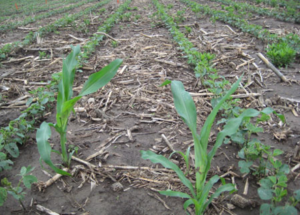
Photo credit: Lizabeth Stahl
Yield Loss. It’s easy to view those scattered volunteer corn plants across the field as insignificant; but as many of you know, any unwanted plants in a field are robbing valuable sunlight, water and nutrients, which results in yield loss. A study by South Dakota State University states that 1 volunteer corn plant per 100 sq ft. can reduce soybean yields as much as 2.5%. As that volunteer corn density increases, so does the significance of yield loss. (Alms et al. 2008). Another study out of Nebraska found that clumps of volunteer corn were even more detrimental than individual volunteer corn plants at the same density across an acre. In their research, yield losses were as high as 40% with a population of 3,500 plants per acre in clumps of volunteer corn vs 10% with individual plants at the same density. (Wilson, R. 2010)
Resistance Management. Probably the most overlooked aspect is the resistance management of corn rootworm (CRW). With volunteer corn left untreated in soybean fields, a food source is provided for the emerging rootworm larva. These larvae will eventually emerge as egg-laying adults, essentially reducing the value of your corn/soybean rotation. While this is important with any volunteer corn, it is especially important with the increased usage of non-CRW hybrids. With these increases in populations of CRW going uncontrolled, we expose the traits to more chances to develop resistance. Here in South Dakota, Western CRW will be our greatest pest to manage as their larvae will emerge the following year and feed on that year’s corn crop. By controlling your volunteer corn in your soybeans, you’re preserving the technology for the long-term control of CRW. Learn more about in-season management of CRW larvae.
Control of Volunteer Corn. Scouting your soybean fields early to monitor populations and height of volunteer corn is important and, just like any other weed, the earlier we can get control the less loss we will have. Controlling early will not only give you a good handle on the eyesore, but will also reduce your expense on chemical. Most labels have a rate of control of corn up to 12 in. After 12 in., the rates vary, but obviously increase as the height increases. Doing a good job of evaluating your fields and making good decisions on control can greatly help your bottom line – as well as the long-term future of your farm.
If you need help making a decision about whether or not to control volunteer corn in your soybean fields, contact your local Producers Hybrids Sales Agronomist or District Sales Manager. We would be glad to help you evaluate your situation!
Resources:
Wilson, R., L. Sandell, R. Klein, and M. Bernards. 2010. Crop Production Clinic Proceedings, Univ. of NE-Lincoln Ext. (Available online at: http://cpc.unl.edu/includes2010/pdf/VolunteerCornControl.pdf?exampleSessionId=1229904124000&exampleUserLabel=Your%20Name)
Alms, J., M. Moechnig, D. Deneke, and D. Vos. 2008. “Volunteer Corn Control Effect on Corn and Soybean Yield.” 2008 North Central Weed Science Society Proceedings, Vol 63, p. 16. (Available online at ncwss.org)
Agronomy | Performance | Soybeans | Yields