Producers Blog
Optimum Planting Dates and Making the Maturity Switch
Our cool, wet spring has delayed corn planting in many areas and I have been hearing some concerns about the maturity of the corn hybrids that growers have chosen for this year’s corn crop. Let’s take a look at two main concerns: 1) when is the optimum time for planting and 2) when should I look at switching to an earlier maturity?
Optimum planting dates
Research done by Jeff Coulter, Extension Corn Agronomist from the University of Minnesota, shows on average a 0.5% yield loss per day from April 25th to May 30th (Figure 1). For example, if you normally average 180 bu/a on your farm, this would mean that on average for every day after April 25th that planting is delayed you could potentially have a yield loss of around .9 bu/a. Another study done at the Lamberton, Morris and Waseca research locations showed similar results (Figure 2).
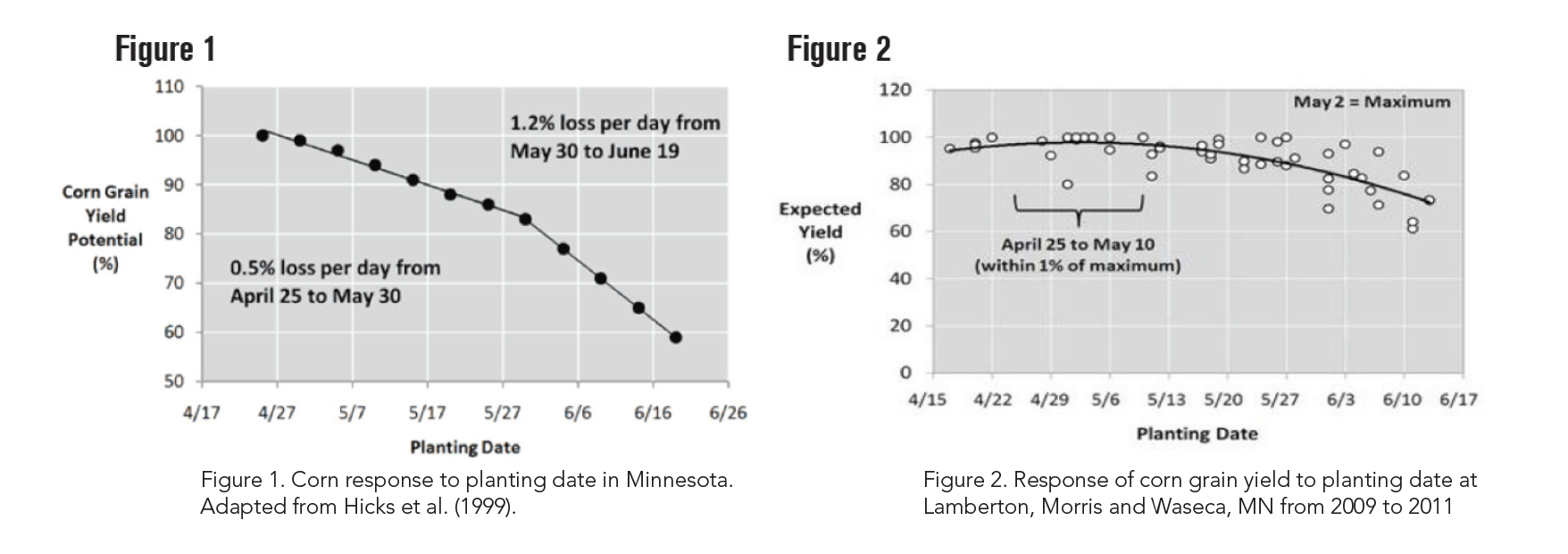
Similar studies have been done in Wisconsin and South Dakota concerning planting dates in relation to yield. Both studies showed similar results, about a 1 bu/a loss in yield per day when planting gets delayed past the 5th-7th of May.
We must keep in mind though that a poor seedbed at planting, even if it is in the desired planting dates, will have a more adverse effect on grain yields than if you were to wait for good soil conditions. If the seedbed is wet and cool, this can result in compaction, delayed emergence and the potential for seed rot and diseases to occur.
Making the maturity switch
The answer to this question will vary somewhat depending on the region of the state that you live in. One of the main factors that will affect this situation is your average frost date in the fall. If you live in the northern half of MN, your frost date will be earlier in the fall than if you live in the southern half of the state, thus reducing the number of days that you will be able to collect Growing Degree Units (GDU’s) to get the corn plant to maturity. Check out this website that shows the average last frost in the spring and also the average first killing frost in the fall for various towns in Minnesota.
Another factor to consider is that the amount of GDU’s that a hybrid typically needs to reach physiological maturity (black layer) will change when planted later in the season. On average, for every day after May 1st that a hybrid is planted, it requires 1.6 GDU’s less per day to reach flowering and 6.8 GDU’s less per day to reach black layer. Therefore, a hybrid planted on May 25th may need 136 less GDU’s to reach black layer than the same hybrid planted on May 5th (20 days X 6.8GDU’s = 136 GDU’s).
There is one thing to keep in mind: although the corn plant may adapt to the amount of GDU’s it needs to get to black layer, the grain fill period will shorten in the hybrid. While none of these studies looked into yield differences from the delayed planting (they were just looking at GDU’s needed to silk and black layer), usually a shorter grain fill period will mean a lower yield potential.
As far as a calendar date to look at switching maturities, I have always said that if you can get your full season hybrid planted by May 25th you should be fine and I would not recommend switching to an earlier maturity. If your planting gets delayed until the following week (May 26 – May 31), I would then recommend switching to a hybrid that is 5 days earlier than the one you originally had planned on planting. If you get delayed until the first week of June, I would then recommend switching to a hybrid that is 10 days earlier than the one you originally had planned to plant.
Start with a plan
The wild card in all of this goes back to Mother Nature. None of us know what kind of summer we will have—will it be wet and cool or hot and dry? Ultimately the weather we have in the summer and fall will determine the outcome of our corn crop, but while we patiently wait, hopefully this will help you have a plan in place when the time comes to start planting.
If you have any questions about planting dates or changing corn maturities, contact your District Sales Manager or Sales Agronomist in your area.