Producers Blog
Mid-Season Crop Scouting in Corn and Soybeans
As you wrap-up your herbicide applications, it’s a good time to start scouting for insects and diseases in your corn and soybean fields. If you still have a planned herbicide pass to make in your soybeans, you will want to take time to scout for insects and diseases prior to that application. In corn, there are several insects to be concerned about yet this year, but we also need to assess any damage caused by corn rootworm (CRW) in order to plan for the next time we plant corn in that field.
Highlighted Corn Insects and Diseases
-
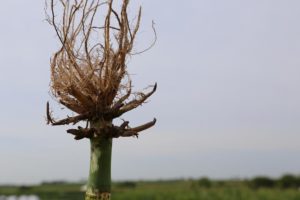
Severe root pruning by corn rootworm larvae can dramatically impact yield. Photo by Erin Hodgson, Iowa State University.
Corn Rootworm – Since most areas with corn are near mid-to-late feeding for CRW, it is time to start digging roots to assess damage. Recent analysis has shown that for every pruned node there is a 15% yield loss. When assessing CRW feeding, ISU suggests that you “adjust management strategies if the average injury is above 0.5 on a 0-3 scale.” However, they have shown economic losses with the average injury level as low as 0.25 on the 0-3 scale. To help you determine your levels of damage, ISU has developed an interactive node-injury scale. We will also want to remember to go back to the fields that had heavy feeding, as the adult CRW beetles may clip silks and cause pollination issues. This is especially true for replanted corn acres, as the fresh pollen and silks will attract the beetles. Treat for CRW beetle control if silks are clipped back to within ½ inch of the ear tip and less than 50% pollination has occurred.
-
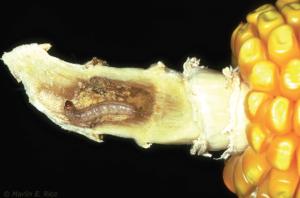
Second generation European corn borers
can tunnel into corn stalks. Photo by Marlin E. Rice.European Corn Borer – One of the first places to start scouting for insects is the replanted acres. Insects always seem to find the latest planted corn. And if you have replanted conventional corn, be sure to watch for heavy European Corn Borer (ECB) pressure as they have been known to cause heavy damage in late plantings. When the average is one ECB per plant for the first generation the yield losses are approximately 6%. Learn more about about ECB scouting and thresholds for treatment.
-
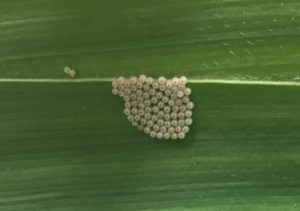
Western bean cutworm egg mass. Photos by Julie Peterson.
Western Bean Cutworm (WBC) is another corn pest that can cause yield losses as well as lowering grain quality. Scout at least five areas in the field and make observation on 20 plants. Depending on grain values, you should treat when 5-8% of the corn plants have egg masses or larvae, and after the field is 95% tasseled. This treatment threshold also holds true for fields with corn varieties that contain the Cry1F trait, which has shown some decreased effectiveness in some areas. Insecticide application timing is very critical as once the WBC enter the ear husk there are no treatments to control them.
While it may be a little early for some to start scouting for diseases, it is always a good idea when you are in the field to take note of any foliar symptoms that might be occurring. There are plenty of apps and guides available for free out there to help you with disease identification. Here are a couple of links with very good information and pictures to help make identification simpler:
- http://cropdisease.cropsci.illinois.edu/corn/
- http://fyi.uwex.edu/fieldcroppathology/files/2010/09/Corn_Foliar_Disease_Cards.pdf
Highlighted Soybean Insects and Diseases
-
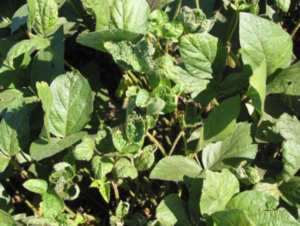
Severe soybean aphid damage. Distorted leaves and sooty mold. Photo by Bruce Potter, University of Minnesota.
Soybean Aphids – While most soybean aphid scouting probably started in June, you will want to continue that through R5. An R5 soybean has a seed that is 1/8 inch long in a pod at one of the four uppermost nodes on the main stem. The three requirements in order to reach the economic threshold for treatment are:
- 250 aphids per plant
- At least 80% of the plants infested
- Populations are increasing
It is important to continue scouting your treated fields. There have been confirmed cases of pyrethroid resistance since 2015 in Minnesota and 2016 in Iowa. Learn more on how to avoid resistance in your soybean fields.
-
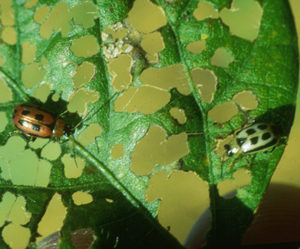
Beetles and foliage feeding. Photo by J. Obermeyer.
Bean leaf beetle (BLB) can be problem this late in the season. However, the soybean would have to be at least 20% defoliated and the BLB populations would have to be increasing to justify any treatments. The best time to scout for them this time of the year is mid-morning and early evening. The beetles will seek cooler shelter in the cracks of the ground during the heat of the day.
-
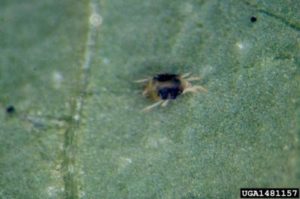
Two-spotted spider mite. Photo by Frank Peairs.
While Two-spotted Spider Mite (TSM) is not a problem every year, it can be when hot, dry conditions persist during the summer months. There are no economic thresholds available for TSM. Use caution when selecting an insecticide for treatment because some pyrethroids can make the problem worse by killing all of the beneficial insects but not killing all of the TSM. There are three conditions that should be met before making an insecticide application:
- Live spider mites should be present
- Leaves must have “stippling” or small yellow spots
- Very dry or drought conditions are currently occurring or are forecasted
-
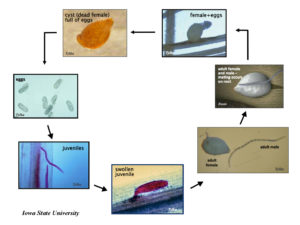
SCN lifecycle. Iowa State University.
Soybean Cyst Nematode – There is nothing that can be done about Soybean Cyst Nematode (SCN) for this year, but identifying them now will help with future management decisions. Above ground symptoms can be confused with many other potential problems. Therefore, it is best to dig roots and gently clean the soil off of them. Look for white or light yellow lemon-shaped bulge on the roots. They can be confused with nitrogen-fixing nodules but SCN are a lot smaller. Once found, a soil sample will best determine your level of infestation. Confirming SCN will also help you determine what management techniques you will have to apply the next time you plant soybeans in that field.
There are many soybean diseases that will begin to show up now. The diseases you may find include Frogeye Leaf Spot, Brown Spot, Cercospora Leaf Blight, Sudden Death Syndrome, Pod and Stem Blight, White Mold and several others. While there are fungicides labeled to control some of these diseases, there are not many thresholds that have been established for when to apply the fungicide. However, there are many universities studying different application timings and most agree that an application at R3 has shown the best response. An R3 soybean has a 3/16 inch pod at one of the four uppermost nodes on the main stem. And for those diseases that can’t be controlled now – such as Sudden Death Syndrome – taking note of their presence will help with future management decisions. The following links have very good pictures that will help with soybean disease identification:
- http://www.cropwatch.unl.edu/soycal/app/index.html
- http://cropdisease.cropsci.illinois.edu/soybeans/
Now that you know what to look for and have the resources, it’s time to get in the field and start scouting. If you find something and you are unsure of what it is, take a picture and send it to your Producers Hybrids District Sales Manager or Sales Agronomist. We will do our best to help you identify the problem!
Resources:
- https://store.extension.iastate.edu/Product/15141
- http://crops.extension.iastate.edu/cropnews/2017/06/corn-rootworm-egg-hatch-peaking-around-iowa
- http://ipcm.wisc.edu/blog/2015/07/corn-rootworm-beetles-and-potential-for-silk-clipping/
- http://cropwatch.unl.edu/2016/begin-scouting-western-bean-cutworm-eggs-corn
- http://www.extension.umn.edu/agriculture/soybean/pest/docs/soybean-aphid-scouting.pdf
- http://crops.extension.iastate.edu/cropnews/2017/02/resistance-management-plan-soybean-aphid
- https://extension.entm.purdue.edu/fieldcropsipm/insects/bean-leaf-beetle.php
- http://crops.extension.iastate.edu/cropnews/2016/07/spider-mite-injury-confirmed-soybean
- https://www.plantpath.iastate.edu/scn/
- http://www.ipm.iastate.edu/ipm/icm/2001/7-2-2001/scoutecb.html