Producers Blog
Making the Corn Replant Decision
Another year, another wild spring in the western Corn Belt. We had a few decent planting windows early (mid-April) with good soil conditions and weather forecasts. In late April, we were faced with an extended period of cooler weather and above average precipitation across a wide area, including a band of heavy snow on May 1. What does this mean for corn that has already been planted? There are several factors that may reduce the final corn population, including imbibitional chilling and cold stress (Imbibitional Chilling Injury of Corn – University of Nebraska) and an increased incidence of seedling diseases due to the extra stress that the young corn plants are enduring.
I would encourage growers to start thinking about which of their early planted fields may face the most risk and be ready with a plan if a replant decision is made. There is a sequence of steps that can be taken to determine if a field should be replanted for the best yield and profit potential.
1. Determine the existing plant population and uniformity.
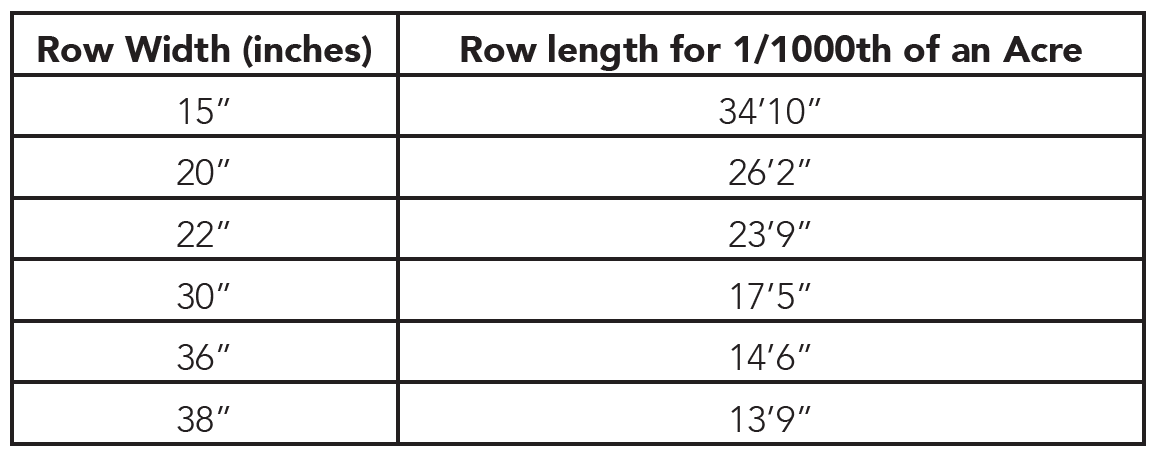
There are several ways to determine the existing plant stand, with the most common being the 1/1000th Acre method. Count the plants in the required row distance and multiply by 1000 to get the current plant population. You will want to take these counts at several spots in the field to get an average.
Table 1. Common row widths and the distance needed for 1/1000th of an Acre
Uniformity of emergence can also affect final yields, but only in the most severe cases will it make economic sense to replant.
2. Determine the expected yields from the existing stand and replant population
The data in the table below comes from Iowa State, so the populations may be a little higher than what we typically see in the western Corn Belt, but the trends should be very similar.
Table 2. Percentage of maximum yield potential for various planting dates and populations
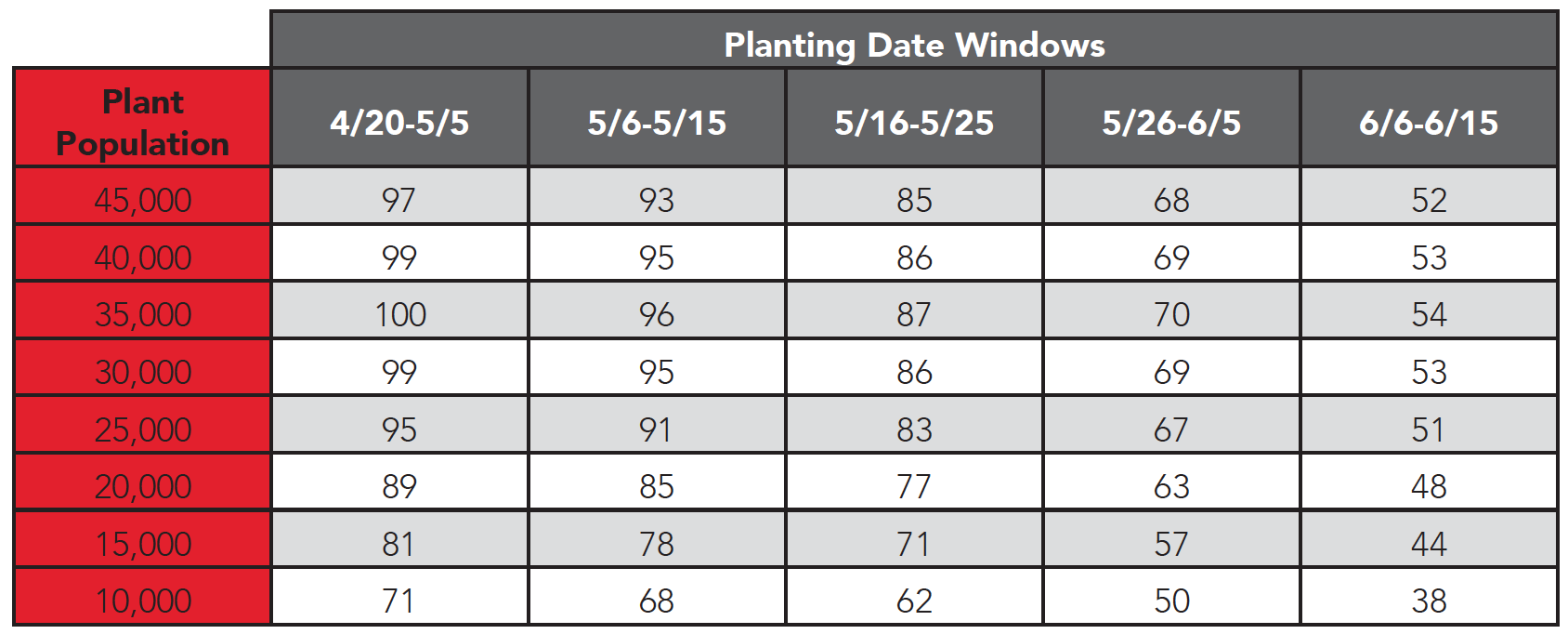
If there are large gaps (4-6’) within the row that are contributing to the reduced population, there will be a further 5% reduction in yield potential. Moderate gaps (1-3’) will reduce the yield potential by 2% (Replant Checklist – Iowa State University). For example, a grower planted corn on April 27th at 32,000 population. On May 20th, the stand counts average 15,000 viable plants, and there are several 5’ gaps within the row. The current yield potential would be about 76%. If the field was replanted by the 25th of May, it would have a yield potential of 87%, which could potentially provide a return over the expenses of replanting. Keep in mind that these yield potentials are averages of many years, and that any single year may be much different. Contact your Producers Hybrids District Sales Manager or Sales Agronomist as soon as possible if you think you may have a replant situation.
3. Terminate the existing reduced stand.
It will usually make economic sense to terminate the existing stand prior to or soon after replanting. This can be done several ways, and the termination costs will have to be taken into account while making the replant decision. Tillage is one of the most consistent and cost-effective options for stand termination, but is not viable in no-till situations. With the widespread adoption of herbicide tolerant crops, the existing stand trait package will also play into the decision. Some of the Group 1 grass herbicides (like Select Max) can be used to terminate Roundup Ready and/or Liberty tolerant corn, but they will usually have a plantback restriction for corn. Check the label to be sure. For corn that is both Roundup and Liberty tolerant (like SmartStax hybrids) a tank-mix of 2-3 pints of Gramoxone and 4-6 ounces of Metribuzin can work well on plants less than the V3 stage. Of course, Roundup or Liberty can be used if the existing stand is not tolerant to one or the other.
4. Switching maturities in replant hybrids.
Many growers will want to switch to an early maturity hybrid in replant situations. This may have some merit if there is a higher risk of early frost. The best yield potential will still come from hybrids that are adapted for that area and maturity zone. Stick with your original maturities up to the third week of May. Research has shown that later planted corn will require less GDUs to reach pollination and black layer than earlier planted corn, so just because a full-season hybrid was planted 30 days later than normal, that does not mean that it will pollinate and mature 30 days later than normal as well. I would recommend shortening the maturity slightly as we get beyond the last week of May and into June, and potentially switching to soybeans depending on crop inputs already applied.
Be aware of which fields are at the most risk for a reduced stand. Take stand counts and then use the yield potential table (Table 2) to determine if replanting the field makes economic sense. You can also find situations where you only need to replant patches or smaller areas of the field. Consult with your District Sales Manager or Sales Agronomist during your decision process. Terminate the existing stand as much as possible to eliminate competition from the original planting. Stick with your full-season maturities through most of May, and look at slightly earlier maturities or soybeans if we get beyond that timeframe.