Producers Blog
How to Select Seed Hybrids and Varieties
One of the most important decisions a farmer can make each year is their corn hybrid or soybean variety selection. The top three factors affecting yield are weather, nitrogen/fertility and hybrid/variety selection. Farmers can’t do much to change how weather affects the crop – other than to irrigate or not plant in front of a cool, wet spell. You can change your fertilizer rates, forms and timing of application fairly easily depending on what’s happening during the season and in your field. However, the hybrid and variety selection process can and should take a fair amount of time and effort due to all the factors that go into making that selection. So how do you identify which corn hybrids or soybean varieties are best for your farming operation?
Consistent high yield performance is the key to selecting products that will perform best on your farm. The best way to identify those products is to look at the plot data from multiple locations and multiple years. Products that show to have high yields over a wide variety of growing conditions will be the best option for most farms. They do not have to win every plot, but they should yield within 10% of the maximum-yielding product in the plot – or at least be ranked in the top 25% of that specific plot. For most products, you can also look at multiple-year data, as well, to help in your decision process. However, there are always new products being introduced. Your best option with those products is to look at as many test sites as possible.
When sorting through plot data, make sure to look at the specifics about each plot. This includes the trait packages, planting and harvest date, grain moistures, previous crop, planting and harvesting populations, irrigation, tillage types, fertilizer rates, soil types, herbicides, fungicides, insecticides, and any other notes you may find on the plot results reports.
 All of these management factors affect the final yield of each of the products in that plot. Keep in mind that some of the management practices used in a plot may not be something you are currently planning on using next year. Take, for example, the use of a fungicide on a plot to help with disease control. It could potentially help a product that is very weak on a disease, yield very high. Most likely, if you plant that product next year and don’t apply a fungicide it will not perform as well for you. Additionally, the application of a fungicide may affect the harvest moisture in a plot as well.
Highlights:
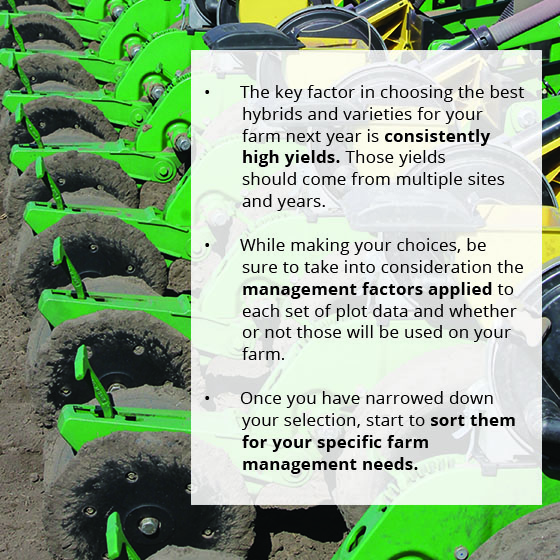
- The key factor in choosing the best hybrids and varieties for your farm next year is consistently high yields. Those yields should come from multiple sites and years.
- While making your choices, be sure to take into consideration the management factors applied to each set of plot data and whether or not those will be used on your farm.
- Once you have narrowed down your selection, start to sort them for your specific farm management needs.
A good place to start the process is with the Yield Results Tool on our website. When you’re #ready4more specific details, your local dealer, DSM, or agronomist is always available to help provide any additional data you may be looking for to help with your decision process.