Producers Blog
How to Schedule the Last Irrigation
It has been a long irrigation season for many, but the finish line is quickly approaching. Timing the final irrigation correctly is important for two reasons: There is a risk of reduced yield with cutting the water too soon, and running too late costs money and could lead to harvest issues. Growers should plan ahead as they may be able to take advantage of soil water reserves or potential rainfall.
There are several variables to consider when determining the correct final irrigation timing, and following a step-by-step procedure will take these into account. The first step is to determine the average crop growth stage in the field. We can use the tables below to determine how much water is needed to finish the crop at each growth stage.
Table I. CORN
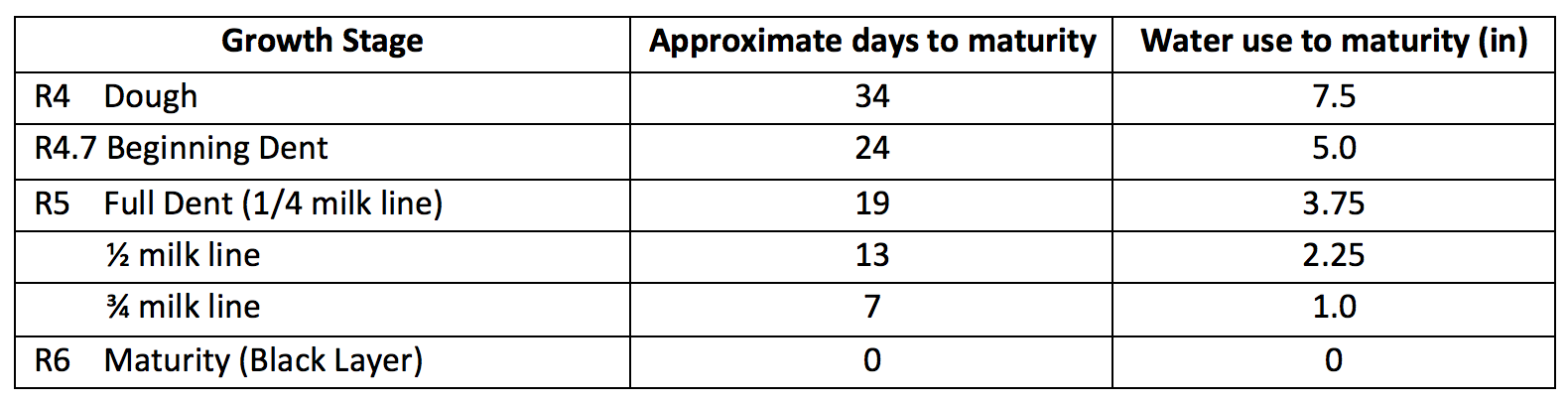
Table II. SOYBEANS

Source: Predicting the Last Irrigation of the Season, NebGuide G1871
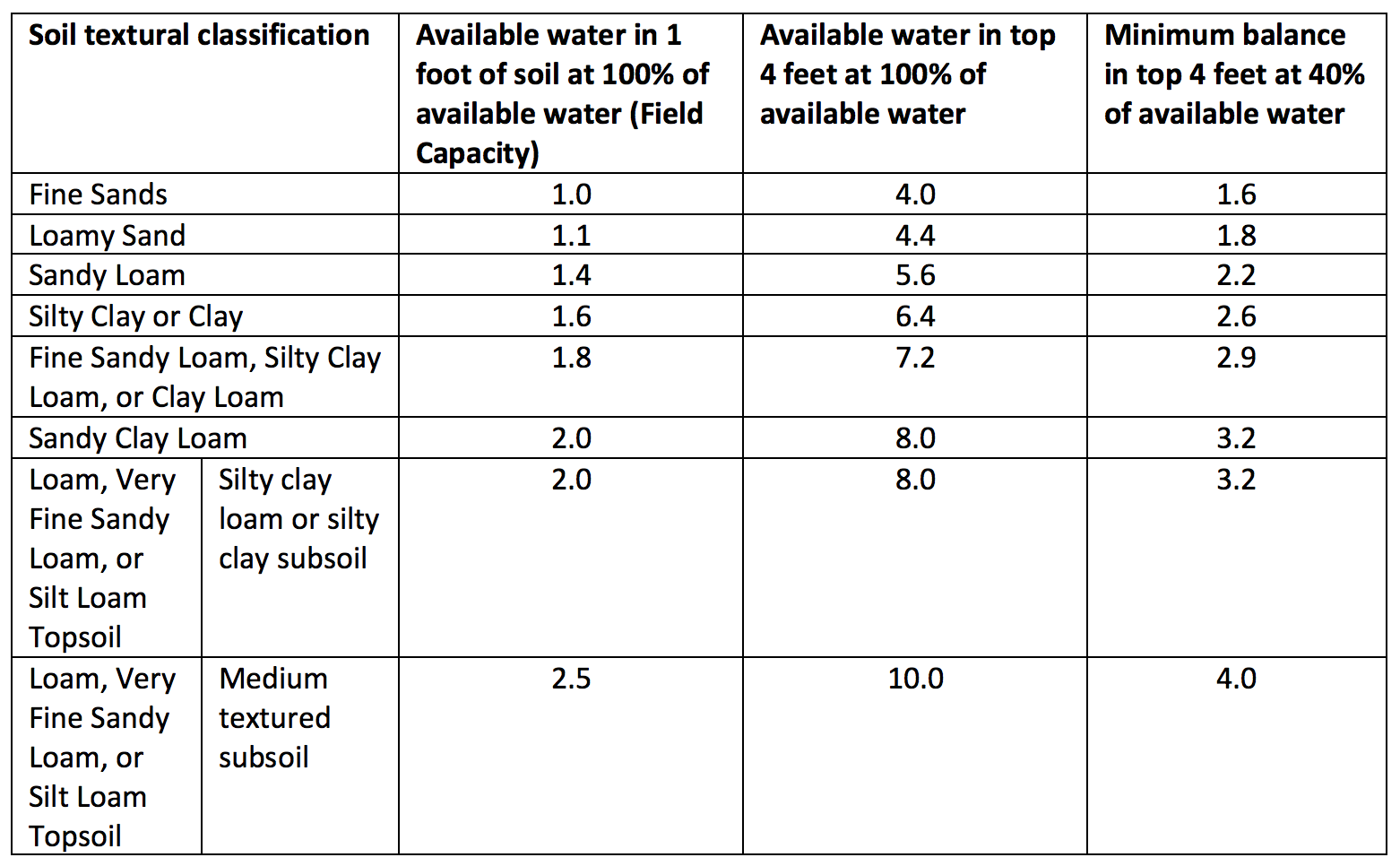
The next step is to determine the soil water content using soil water sensors or the Hand-Feel method as outlined in the USDA-NRCS publication “Estimating Soil Moisture.” We will take this percentage of moisture in the soil and multiply it by the total soil available water capacity (determined by the soil texture, see Table 3 below) and then multiply that by the active root zone depth.
Example 1 – A Silty Clay Loam soil can hold about 7.2 inches of plant-available water in the top 4 feet (the active root zone depth) at field capacity or 100% soil water content. If we can determine that our current soil water content is 75% (either using soil moisture sensors or the Hand-Feel method), then we would have 5.4 inches of plant available water.
Table III. Total soil available water capacity determined by soil texture.
Source: Predicting the Last Irrigation of the Season, NebGuide G1871
We want to have a minimum balance of soil water remaining when the crop reaches maturity, and that level is 40%. Using our above Silty Clay Loam soil, we can calculate that minimum balance at maturity to be 2.9 inches (0.40 X 7.2). Subtract the minimum balance from the current plant-available water to get the amount of plant-available water remaining in the soil. From our example above, we would have 2.5 inches of remaining plant-available water for this Silty Clay Loam soil (5.4 – 2.9 inches).
Continuing to use our Silty Clay Loam example, if we have a field of corn that is just beginning to dent, we can see from Table 1 that it will need about 24 days and 5.0 inches of water to reach physiological maturity. We will subtract this amount of water needed to take the crop to maturity from the remaining usable water (2.5 – 5.0 = -2.5). Since the result is a negative number, we will need an additional 2.5 inches of water either from rainfall or irrigation to finish the crop.
Example 2 – We have a Sandy Loam field that is at 75% soil water content. That puts the current soil water amount at 4.2 inches in the top 4 feet (0.75 X 5.6, from Table 3). We still want to keep our minimum balance at 40% or 2.2 inches, so we can also calculate that our remaining usable water is 2.0 inches (4.2 – 2.2 inches). There are soybeans growing on this field and the leaves are starting to turn yellow. Looking at Table 2, we can see that soybeans at this stage need 10 days and 1.9 inches of water to reach maturity. Subtracting this number from our remaining usable water yields a positive 0.1 inches (2.0 – 1.9 inches). Since it is positive, there is no additional applied water needed to take this field to maturity.
In summary, we start by calculating our remaining usable water from the soil texture (Table 3) and the average current percent soil water content. Once we have this number, we can subtract the amount of water needed to take the crop to maturity (Table 1 or 2) to determine if we have enough water available or how much more we need to apply. We can track crop water use rates and rainfall and only irrigate if rainfall will not meet the water requirements.
It may be tempting to turn the wells off earlier after a long irrigation season, but by using the variables above we can accurately determine just how much more water is needed to finish the season strong. There is a worksheet available on the UNL Extension NebGuide G1871 that is very useful for laying out the sequence of steps. If you’d like to walk through this with a Sales Agronomist in your area, reach out to your District Sales Manager and we’d be happy to help.
Source:
Yonts, C. Dean, Steven R. Melvin, and Dean E. Eisenhauer. “Predicting the Last Irrigation of the Season.” NebGuide (2008): 1-4.Http://extensionpublications.unl.edu/. University of Nebraska-Lincoln Extension, June 2008. Web. 21 July 2017.
Agronomy | Corn | Performance | Soybeans | Yields