Producers Blog
How to Identify Late-Season Corn Diseases
As you are out walking your corn fields looking at rows and ear length to see what yield potential there is this fall, keep an eye out for a couple of diseases that can be detrimental to corn yield if found in your fields. One of these diseases, Northern Corn Leaf Blight, can be managed yet this year and yield losses may be minimal if found early enough. Unfortunately if the other one, Goss’s Wilt, is found there isn’t much a person can do for this year. But there are things that can be done to reduce the potential for this disease to show up in future years. Let’s take a look:
Northern Corn Leaf Blight and Goss’s Wilt
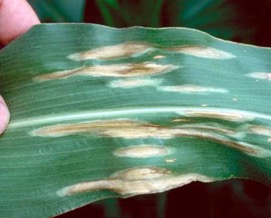 Northern Corn Leaf Blight (NCLB) can show up earlier in the year on corn, but most times we see it later in the growing season due to the plant leaves needing to be wet for 6-18 hours in order for the infection to occur. Typically, in July and early August, we have enough heat that the leaf area dries off before 6-18 hours and thus the infection will not occur. An exception to that would be if we have a cool, wetter summer, which may allow for favorable conditions for infection to occur. But under a normal year, typically we see infections starting more in mid-late August once we start getting some cooler nights with more, and longer, periods of dew.
- Symptoms of NCLB appear as long, cigar-shaped tan or grey lesions on the leaf surface. The most critical time of infection as far as potentially hurting yield is the two weeks prior to and the two weeks after tassel. If the lesions start early enough in the growing season, they can become rather large, up to 7 inches, and multiple lesions may run together to form large areas of dead tissue on the leaf. If enough lesions form on the leaf surface, and they are at the ear leaf or higher, photosynthesis may be hindered and thus yield loss can occur. If the infection sets in early enough, yield loss may be as high as 30%.
- What you can do: Weather is going to be the main factor in the severity of NCLB infection. There are hybrids that have partial resistance to NCLB; these partially resistant hybrids may still have lesions on them if the disease pressure is high enough, but usually these lesions will turn a yellowish color and not die completely. They also typically have lesser number of lesions on the plant and often have less fungal spores than a susceptible plant. There are also resistant hybrids on the market, but keep in mind that these are Race specific, so if you have a different race of NCLB in your field you will still see infection.
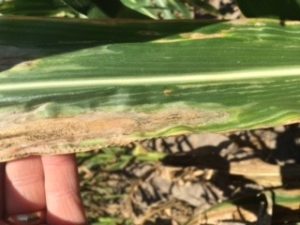 Goss’s Wilt is more prevalent in The Western Corn Belt, but over the years it has moved as far north as Central Minnesota. While this disease can show up early as systemic Goss’s Wilt, most times it shows up later in the growing season as a leaf blight. The one thing that this disease needs to infect a corn plant is an entry point. This can happen in many ways: wind storms that cause leaf stripping, hail damage, mechanical injury or even insect damage. The bacteria usually overwinters on corn residue, but I have personally seen it infect plants that were on last year’s soybean ground.
- Symptoms of the leaf blight version are large, water-soaked lesions that start at the top of the plant and move their way down the plant as the disease progresses. As these lesions progress, they start to form little black “freckles”. These “freckles” cannot be rubbed off the leaf. You may also start to see an ooze of a bacterial exudate that will look shiny when dry. These symptoms can look like drought stress in a dry year, so sometimes it’s hard to diagnose what is happening. There are multiple places you can send in the leaves that are in question to get a positive ID if it is Goss’s Wilt.
- What you can do: Like SDS in soybeans, Goss’s Wilt is a bacterial disease, so fungicide use will not help with prevention. The best way to help prevent Goss’s Wilt is hybrid selection as some hybrids show a good tolerance to this disease while others can be quite susceptible. Rotation can help also, but this disease can stay in the residue for more than a year if the environmental conditions are favorable. Another thing that may help is tillage as it helps bury the residue and speed up its decomposition.
Right now, most of us are excited to get into our fields and start looking at yield potential for this year’s crop. While doing this, keep an eye out for any possible disease issues that may be developing in your field. Now is the time to identify any issues you may have: once we get to harvest and everything is mature it is oftentimes difficult to determine what happened. If you’d like us to come walk your field, please contact your local sales agronomist or your district sales manager. As we all get ready for another harvest season, please be careful and stay safe!
Sources:
Wise, Kiersten. “Northern Corn Leaf Blight.” Purdue Extension (2011): 1-3. Www.extension.purdue.edu. Purdue University, June 2011. Web. 21 July 2017.
Wise, Kiersten, Gail Ruhl, and Tom Creswell. “Goss’s Bacterial Wilt and Leaf Blight.”Purdue Extension (2010): 1-3. Www.extension.purdue.edu. Purdue University, May 2010. Web. 21 July 2017.
Agronomy | Corn | Performance