Next Year’s Crop Depends on What You See and Do This Fall
There are many things to take into consideration when it comes to planning for next year’s crop and it all starts in the combine this fall. Here are three key points you will need to consider already this fall:
- Check your combine settings.
- Be aware of soil moisture conditions.
- Take note of what you see from the current crop in the field.
For those of you that are no-tillers, last fall’s combine settings were very important with the cool, wet start many of us had this past spring. If your combine was not spreading the chaff evenly, it may have affected your corn emergence. This not only affects no-till, it also affects those that do minimal or conventional till, just to a lesser degree. The areas with heavier residue cover will stay wetter and cooler longer into the spring, therefore delaying germination and/or causing uneven emergence.
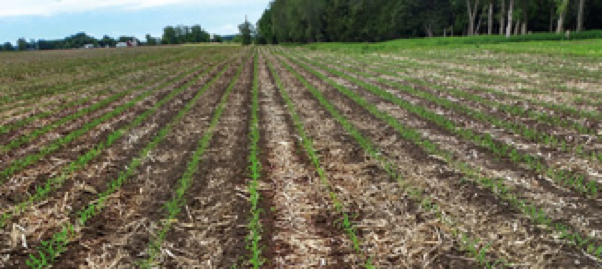
Uneven corn emergence caused by uneven chaff spreading in the fall.
https://www.no-tillfarmer.com/ext/resources/images/issues/2015/CTG-August/2.jpg
Be aware of soil moisture conditions and the use of heavy equipment and tillage implements on saturated soils. Compaction caused at any time of the year can result in yield losses for multiple years. Doing things such as decreasing axle loads, reducing ground contact pressure and controlled traffic patterns can greatly reduce your depth and areas of compaction. Switching to a field with drier soil conditions or waiting an additional day now will mean fewer problems next spring – and potentially for several years.
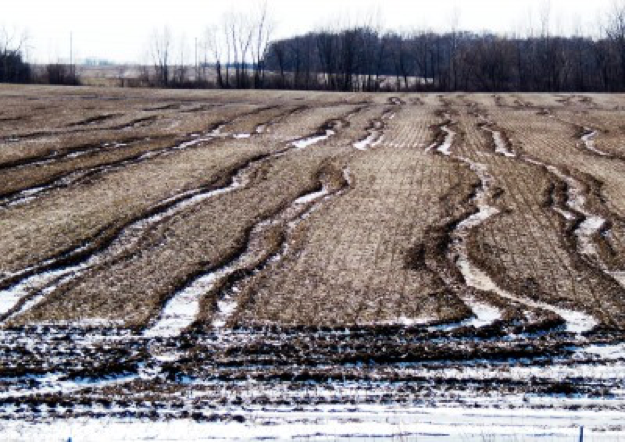
Compaction caused by combine during a wet fall.
http://www.michiganfarmer.com/sites/michiganfarmer.com/files/styles/article_featured_standard/public/harvest-ruts-Mike-Staton-MSU-0320M1-3048A.jpg?itok=TC3A7Jcz
Taking notes on what you see in the field this fall will help with your decision-making process for at least the next two years. It is a great time to take note of any standability issues, and whether or not it occurred at the stalk or down at the soil line near the roots. This can help with decisions on whether to plant that variety again and what you may have to watch out for the next time. Most growers will also want to take note of the lowest-yielding areas, but be sure to also note the highest-yielding areas. You may be able to apply things that helped the highest-yielding acres perform well to the lower-yielding acres and improve your field average. In soybeans, check for white mold in the lower-yielding areas as we have seen this disease showing up in a few new areas this year. This will also help remind you to select resistant varieties the next time you plant soybeans in that field. Learn more about taking notes during harvest.
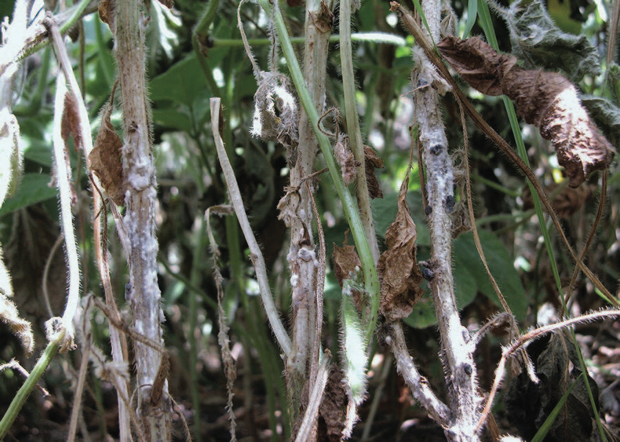
White mold on soybeans. http://cropprotectionnetwork.org/wp-content/uploads/2016/03/Fig18_ScoutingSoybeanStemDiseases_2.jpg
If you have any questions about what you’re seeing in the field, please contact your local Producers Hybrids dealer or Sales Agronomist.