Producers Blog
How to Identify Late-Season Soybean Diseases
White Mold and Sudden Death Syndrome are two diseases that show up later in the growing season in soybeans. Since both of these diseases typically occur during pod formation and pod fill, they can drastically reduce yields in soybeans and are two of the biggest yield-robbing diseases in soybeans that we typically see in a growing season. Let’s take a closer look at them:
Sclerotinia White Mold (SWM) will only show up later in the season in soybeans and is brought on by wet, cool and humid conditions at flowering. SWM may be more prevalent in fields with:
- a past history of SWM
- higher plant populations
- narrow row spacing
- high yield environments that typically have more vegetative growth
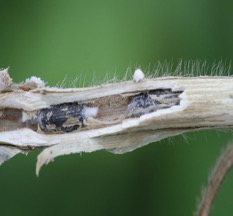
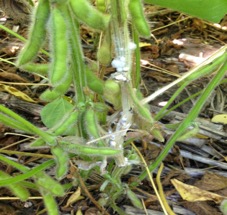
Symptoms of SWM infection usually are first seen as a white, cottony-like mold that starts to infect the main stem of the soybean plant. As this mold progresses, it will start to infect the branches of the soybean plant and eventually the plant will start to wilt and die. Once the plant dies, if you split the stem length wise you will find little black Sclerotia in the pith of the stem.
What you can do: While no soybean variety on the market today is resistant to SWM, there are varieties that are much more tolerant than others. Also, some fungicides are labeled for SWM suppression. Not all fungicides on the market today will have efficacy against SWM, so make sure to read the label before using a fungicide to help against this disease. The optimum time for a fungicide application on soybeans for SWM is at R1 (beginning flower), but some studies have shown some control applied as late as R3 (beginning pod set). However, once the disease is present, no fungicide on the market today will get rid of it.
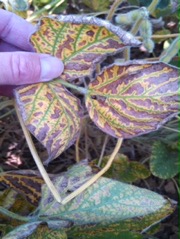 Unlike SWM, Sudden Death Syndrome (SDS) can show up earlier in the year in soybeans, but typically symptoms start to show up later in the season in early August. Even though SDS affects the leaves (this is the first symptomology we typically see), it is actually a root disease that sets into the plant shortly after planting. Factors that favor SDS development:
- early planted soybeans
- cool and wet soil conditions at planting
- compaction
- SCN present in the soil
Symptoms of SDS start off as necrosis (dying tissue) in between the veins on the leaf, which stay green. This necrosis on the leaves mimics Brown Stem Rot (BSR), but there are two ways to distinguish which disease is present:
- Leaves will fall off the branches with BSR, while they tend to remain attached with SDS.
- The easiest way to tell what disease you are looking at is to split the stem lengthwise. If the center, or pith, of the plant is brown, it is BSR. If it is white and healthy looking, it is SDS.
What you can do: Since SDS is a soil borne pathogen, fungicide applications in season will do nothing for controlling it. Soybean variety selection can help tremendously as some varieties are much more susceptible to SDS than others. Selecting a variety that has good SDS tolerance, along with SCN resistance is a good way to help against the potential for SDS infection in a field. Another option to help reduce the potential for SDS development in soybeans is the use of ILeVO seed treatment at planting time. Keep in mind that none of these options are listed as able to control SDS; they all help suppress the amount of infection. If the level of the SDS pathogen is high enough in a given field, you will still probably see some signs of infection to soybeans plants.
Right now, most of us are excited to get into our fields and start looking at yield potential for this year’s crop. While doing this, keep an eye out for any possible disease issues that may be developing in your field. Now is the time to identify any issues you may have: once we get to harvest and everything is mature it is oftentimes difficult to determine what happened. If you’d like us to come walk your field, please contact your local sales agronomist or your district sales manager. As we all get ready for another harvest season, please be careful and stay safe!
Sources:
Mueller, Daren. “Managing White Mold in Soybean.” Managing White Mold in Soybean | Integrated Crop Management. Iowa State University Extension and Outreach, 2 July 2014. Web. 21 July 2017.
Chilvers, Martin. “White Mold of Soybeans and Foliar Fungicides.” MSU Extension. Michigan State University Extension, 24 June 2015. Web. 21 July 2017.
Malvick, Dean. “Sudden Death Syndrome.” Sudden Death Syndrome : Crop Diseases : University of Minnesota Extension. University of Minnesota Extension, July 2009. Web. 21 July 2017.