Producers Blog
In-Season Management of Corn Rootworm Larvae
The planting season of 2017 definitely had its challenges. The crops have already faced a number of stresses including flooding rains, excessive winds, and snowy, 30-degree cold fronts. As we look forward to the warm summer months to come and closing the book on the cold, soggy spring, it is important to look at possible pests that could add additional stresses and decrease our profitability. One of the biggest yield-robbing pests in corn is Corn Rootworm (CRW). The United States Department of Agriculture estimates that CRWs cause $1 billion in lost revenue each year. Let’s briefly discuss the pest during larvae stage, how to scout for it, and what options are available in-season if a rescue treatment is needed.
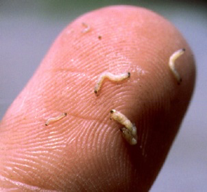
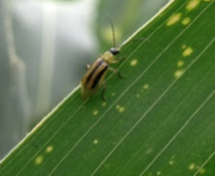 The Pest: In the Corn Belt there are two types of CRW that cause the most damage as larvae and adults: Western and Northern CRW. These species lay eggs the previous year that overwinter and hatch around June or when approximately 500 GDUs have been accumulated (50% larval hatch occurs at 700 GDUs). There are three larval instars before the insect pupates and emerges as a beetle. Each instar lasts approximately 7-10 days as the larvae feed on corn root hairs and nodal roots causing the most damage during the 3rd instar before the pupa forms.
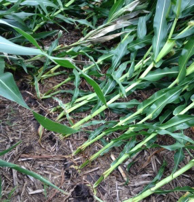 Scouting: To scout, simply dig around the root zone of a corn plant and carefully sift through the soil looking for the CRW larvae. Visually, they are off-white slender worms that are <1/8” long at 1st instar and usually no bigger than ½” lon
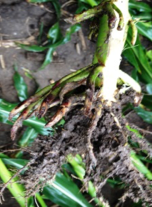 g at 3rd instar. They have a brown head and a blackish flat spot on their tail, making it look like they have two heads. When sifting through the soil, you can choose to place the soil on a black piece of plastic so it is easier to see, or you can place the roots in a bucket of water and softly break up the soil from the roots of the plant. The larvae will float to the top making it easier to count. Repeat this method 2-3 times at 4-5 different locations in the field. Plant lodging and root pruning/discoloration are visual characteristics of plants with CRW damage. Severe root injury interferes with the roots’ ability to transport water and nutrients, reduces growth, and ultimately results in lower yields.
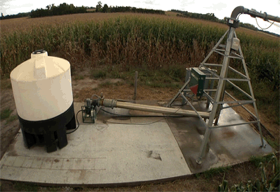 Treatment: There is not a university/industry economic threshold for CRW larvae but usually a treatment is warranted when an average of 2-3 larvae are found per dig. If this threshold is reached, the best form of rescue treatment is through chemigation*. This is when an insecticide is applied through a pivot irrigation system and the water is used to move the insecticide to the area of infestation. The timing of the rescue treatment is critical. As mentioned above, the most damage is done at the 3rd instar, but after this stage the larvae enter the non-feeding pupate form and money invested in a rescue treatment will have little return. Because of this, it is important to detect CRW infestations early (1st or 2nd instar) in order to have an effective application. If the field does not have a pivot, cultivator applications and ground/aerial applications have been used but with far less effectiveness. Cultivator applications are somewhat limited due to the height of the corn crop. Ground/aerial applications efficacy really drops off because of the inability to incorporate into the soil and the dependency of an adequate rain event. Therefore, a grower can be limited on his options if he does not have a pivot and should be proactive in his management in order to control potential problems.
The ultimate goal is to avoid rescue treatments all together if possible and to have a plan to control CRW before a rescue treatment is needed. Actively scouting now for CRW larvae and knowing what type of CRW pressure a field experienced the previous year is crucial for future pest management decision. Producers Hybrids has a vast selection of SmartStax® corn products, which have shown great control with multiple modes of action against CRW larvae. Also, we have a top-yielding bean lineup if rotating to an alternative crop. Contact your local Producers Hybrids DSM.
*Consult with your Ag distributor on products and rates available for chemigation and always read and follow pesticide label directions.
Resources:
Purdue Crop Diagnostic Training and Research Center, and Integrated Pest Management, comps. Corn & Soybean Field Guide. 2013 ed. West Lafayette, IN: Purdue U Cooperative Extension Service, 2013. Print.
Wright, Bob. “Scouting for Corn Rootworm Larvae and Treating Postemergence.” UNL CropWatch. University of Nebraska-Lincoln, 27 June 2013. Web. 20 May 2017. <http://cropwatch.unl.edu/scouting-corn-rootworm-larvae-and-treating-postemergence-unl-cropwatch-june-27-2013>.
Bissonnette, S. M. Field Crop Scouting Manual: A Guide to Identifying and Diagnosing Pest Problems. Champaign, IL: U of Illinois Extension, College of Agricultural, Consumer and Environmental Sciences, 2010. Print.
Photo credit: Scott Dugan, cropwatch.unl.edu, www.peanutdocs.ncsu.edu
Corn | Performance | Yields