Producers Blog
Evaluating Corn Plant Stands
You only get one “good” chance at planting a crop in a growing season, so it is very important to make sure that the crop is started off in the best possible scenario. Evaluating plant stands after emergence is a critical step to ensure this year’s crop is off to a good start and is a great opportunity to learn from this year’s plant stands to apply any changes (if needed) to future planting seasons.
Over the years there has been much talk about singulation in corn and the importance of not having any doubles or skips in your corn stand.
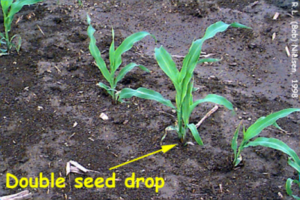 Doubles are a concern because two plants that are too close to each other are essentially fighting for the same nutrients, moisture and sunlight and often leads to both plants having a smaller-than-normal ear size.
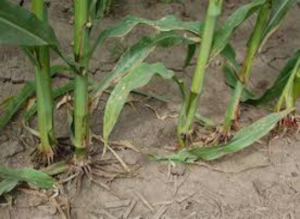 Skips or gaps in a plant stand lead to a lower-than-desired population and often leads to lower yield potential due to the lack of plants desired.
Uniform plant spacing
It’s not only about avoiding doubles and skips; another important thing to look at is uniform spacing between plants. Paul Johnson, South Dakota State University (SDSU) professor and SDSU Extension Weed Science Coordinator, did a study on plant spacing and found that any time your plant spacing varies by more than 2.75 inches you are losing yield potential in corn. For every inch that you are over this 2.75-inch variation, his study showed that you are losing 4 bu/acre. What leads to uneven plant stands? Here are some factors:
- Row units not working properly. It is a good idea to run your row units through a meter stand to look at how they are working. With a vacuum planter, seed plates may be warped, seed holes may be plugged or slightly obstructed, and brushes can become worn out. On finger pickup units, the springs may become weak.
- Planting speed. Even with the use of newer technology – such as the many products offered by Precision Planting – higher planting speeds can still lead to lower plant stands. A study done at the Monsanto learning center showed that even with eSet meters, for every 1 MPH increase in planting speed a reduction of 2,000 plants/acre was observed.
- Vacuum Pressure. Too little of pressure can lead to seeds falling off before they hit the knock off, resulting in skips. Conversely, too much pressure can lead to two kernels being on one cell, which can cause doubles to happen.
Uniform emergence
Recently, emphasis has been placed on uniform emergence in corn. Research has shown that corn plants with delayed emergence fall behind right away – and they never catch up. Multiple studies have shown that a delay of up to a week in emergence can lead to a 6-8% reduction (or higher) in yield. Most years we do not see this much variation when it comes to emergence, however, recent studies have found that yield reductions start to occur when corn emergence is delayed by hours, not days. In an  article by Dan Miller of Progressive Farmer, a study found that the 25% of corn plants that emerged 12 hours after the first corn plants had 23.8% fewer kernels on them than the first-emerging plants. This is why it is crucial to get every plant off to an even start in the spring. What causes uneven emergence? Here are a few culprits:
- Uneven soil temps. This is especially true early when soil temps are below 55 degrees. Studies have shown that once soil temps have reached 55 degrees, emergence is rather even at around 7 days to emerge all the way up to 70+ degree soil temps. But corn plants can take 7-13 more days to emerge at 50-degree soil temps than 55-degree soil temps. Also, with early planting when soil temperatures are around 50 degrees, the soil temperatures are more prone to have variability due to the more variable, and often times much cooler, ambient air temperatures.
- Residue. This can lead to cooler soil temps where heavier amounts of residue are found. These areas of higher residue can also lead to less seed-to-soil contact.
- Drainage. Drier areas in fields will typically warm faster than wetter areas, which can lead to uneven emergence.
- Uniform planting depth. Seeds placed deeper in the soil will take more time to emerge. This will be exaggerated with early planting as there will be a more drastic change in soil temperatures the deeper you go.
- Uniform soil moisture. Uneven soil moisture can lead to some plants not being able to imbibe enough moisture to start the germination process.
Realistically, we have only one good shot at getting our corn crop off to a good start. Sometimes Mother Nature does things to hamper this that are totally out of our control. However, for the most part, we can control the things we talked about above. Scouting your fields during and after emergence is a great way to learn what is going on in your field. Even if there is nothing wrong – which hopefully is the case – by walking your fields you can still use what you did right this year and apply it in future years.
Want someone to walk your fields with you and provide some insight? Call your District Sales Manager or get in touch with your Sales Agronomist. We’re here to help and would be happy to come out and take a look at what’s going on in your fields.