Producers Blog
Why You Should Evaluate Seeding Rates
Planning time is upon us and it is also a good time to evaluate what has worked well in the past year. At this time, you may be taking a look at the many factors that play into crop production to see what changes need to be made. Sometimes these are looked at on a field-by-field basis but more often are looked at across the entire operation.
Seeding rates is one thing that must be evaluated on a field-by-field basis – and a lot of times it needs to be evaluated in regards to specific areas of the field. Many look at the ear type of the plant and think a flex ear can be planted thinner while a fixed ear needs to be thicker. However, planting rate goes beyond that and several factors need to be considered. For example: is the plant structure more upright leafed or relaxed leaf? What is the row spacing? What is the current fertility plan? Is my field irrigated or dryland?
Let’s take a look at a few of these considerations. Regardless of ear type, if a plant is more upright leafed, it tends to handle higher populations more effectively. This is partly due to the plant being able to intercept light and perform photosynthesis better. This plays into row spacing as well. Upright plants tend to perform in narrow rows for the same reason. If population is being increased in order to raise yield, fertility also needs to be increased accordingly. Crops can mine nutrients out of the soil and often do so to gain higher yields. However, as populations increase, that cache of nutrients has to go across more plants and the overall yield increase is diminished.
Population is also key in irrigation versus dryland. In Producers Hybrids sales territory, dryland means many different things. In areas to the east like Iowa, Minnesota, and northern Missouri, dryland is much different than west river South Dakota, Western Kansas and Colorado. Populations in the west may run as low as 8,000. Many believe that ear type is very important because of this; however, this is not the case. Producers Hybrids has several semi-determinant ear products that excel in these situations – along with several full-flex hybrids. In these situations, the ability to handle stress is often more of a determining factor than ear type. In a 2016 population study in Bethune, CO, 5893VT2PRIB and 6103VT2PRIB (both semi-determinate ear types) had similar performance to 5624VT3PRIB (a semi-flex hybrid). Despite differing ear types, all three products in this study have proven to handle stress exceptionally well and perform in low population situation.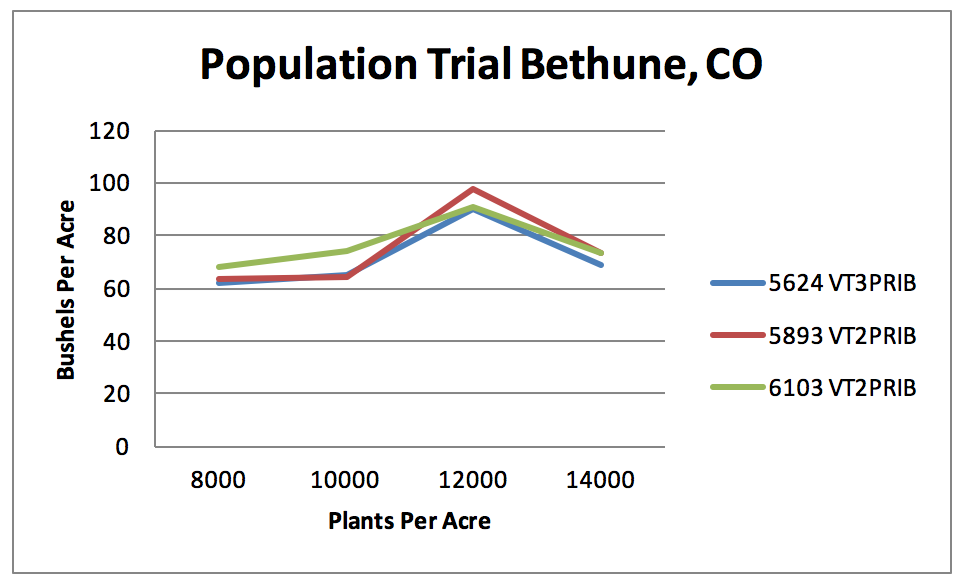
The best way to determine what population will work best for your product selection is working with your local Producers Hybrids dealer, District Sales Manager and your regional Sales Agronomist. For more information on local plot results and product technical sheets, check out our Yield Results Tool and Product Guide Tool on yourdealersite.thinkcaliber.com.