Producers Blog
In Your Fields: Corn Ear Mold
It seems that every year we face something during the growing season we had not planned for. Even with the most thoughtfully prepared crop plan, Mother Nature shows us that she always has been and always will be in control of our growing season. This year, some regions of Producers Hybrids country are seeing higher than average amounts of ear rots showing up in corn fields.
In this article, you will find more information about:
– Identifying corn ear molds
– Causes of these diseases and what you can do to manage this year’s crop
– How you can prevent this from happening next year
Corn Ear Molds
Higher than average precipitation combined with high humidity and temperatures aids in corn ear molds forming. The husks had loosened up on the ear while the ear was still upright, allowing for moisture to collect inside these husks and sit in the kernels of the ear.
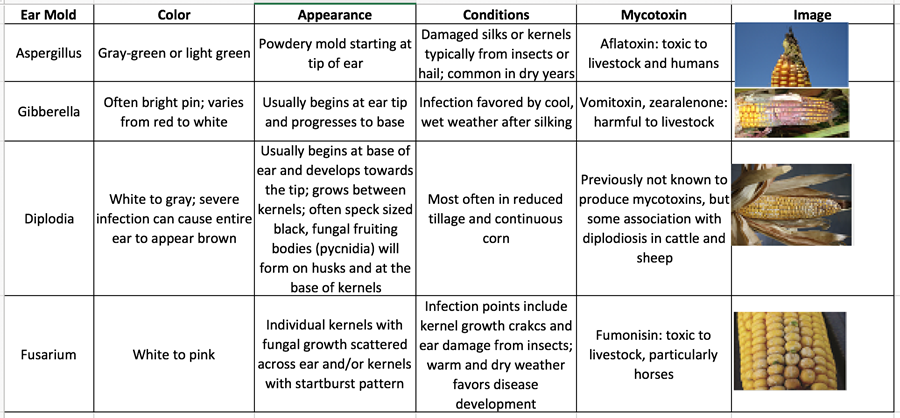
Another way these molds form is from insects feeding on the kernels. This allows for an area to be “opened” up and allows for the start of molds to form. Below is a “cheat sheet” that helps identify the most common ear molds.
Effects of Ear Molds
One issue is that some of these molds can contain Mycotoxins, which are harmful to certain types of livestock. But, just because it has the ability to contain Mycotoxins doesn’t necessarily mean it is a carrier. If you are going to be feeding grain with an ear mold that could contain Mycotoxins, it is best to send a sample in to see if is suitable for livestock. The chart above will help you identify which molds may have Mycotoxins and what animals they may affect.
Another issue, depending on the amount of grain that is moldy, may be storage. Moldy grain will not store as well as clean grain, so keep an eye on the amount of grain that is affected by these ear molds. If the percentage of grain affected right now is low, harvesting and running that grain through the dryer will prevent the mold from getting any worse and should not cause storage issues.
Managing Corn Ear Molds
The best way to limit the risk of seeing ear molds again in your fields next year is to rotate away from corn for a year. This will allow the residue to break down in the soil and eliminate the pathogen that caused the ear mold to form. If you cannot rotate away from corn, burying the residue as best as you can will help break down the residue faster for next year. Another way is to keep insect pressures low, thus reducing the chance of kernel feeding. Hybrid selection may help as some hybrids have a more open husk to them, thus allowing the chance for moisture to collect in the ear – but keep in mind that a hybrid with a closed, tight husk usually does not dry down as fast in the fall.
Agronomy | Corn | Performance