Producers Blog
4 Practical Management Tips for High-Yielding Soybeans
We’ve all seen the headlines over the last few years: 150, 160, even 170 bushels. No, I’m not talking about national corn averages, but record soybean yields. Since we have seen it happen several times now, we know that the soybean has the genetic capacity to produce at least 150+ bushels per acre. How does the plant achieve that and what steps can the “normal” grower take to increase their yields?
Even soybeans in a rain-fed field in Nebraska can produce enough pods to approach these record-setting yields. (If you’ve ever tried to estimate soybean yields by doing pod counts, you’ve probably seen this, as well.) However, every stress that the soybean plant endures over the last half of the growing season can cause those pods to abort or fall off. Knowing this, we can start to look at management practices that either increase the number of pods produced, retained, or both.
Obviously, weather has the final say and a good late August/early September rain counts for a lot in soybean production, but how can we put our farms in the best position possible to maximize our profit potential?
- Variety Selection
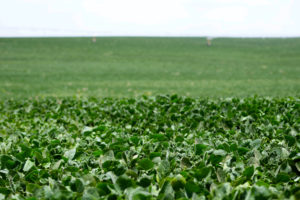 The most important decision a soybean grower makes is choosing the right varieties for their environment. Picking full-season soybeans with high yield potential and the right defensive package will allow them to maximize both pod production and retention.
- Fertility and pH
Soybeans prefer a soil pH around 6.0-6.8. Many soils may require lime additions to reach these levels. Soybeans are not as tolerant to very high pH levels either, and will require different management once we see soil test levels about 7.5.
In the past, many growers depended on soybeans to scavenge residual nutrients from the more intensively managed corn crop. Today’s higher yielding soybeans demand much more attention for the highest profit potential. A 70-bushel soybean crop will remove 56 lbs of Phosphate and 98 lbs of Potassium with the grain, and it would not be likely to maintain these yield levels if we are relying on those nutrients being available from the preceding corn crop.
Soybeans produce their own nitrogen via N-fixing bacteria that colonize the root systems in nodules, and well-nodulated soybeans can produce enough nitrogen for 60- to 70-bushel soybeans. Yields above this level will likely require additional nitrogen, whether it comes from mineralization, manure, or fertilizer applications. Additional nitrogen applications must be managed carefully, however, as too much available nitrogen early in the season can hinder root nodule development and have a negative impact on yields.
Foliar fertilizers may have a place in correcting any deficiencies that show up on a mid-season tissue test, but should not be counted on to provide significant amounts of nutrients. Early season fertility management is key, and will allow the soybeans to produce a higher number of pods, as well as helping the plant to handle late-season stress and retain more pods.
- Planting Practices
Earlier soybean planting has typically shown a positive yield response by giving the plant more time to spend in vegetative growth, which increases potential pod sites for when the plant begins reproductive growth. Seed treatments become more important with earlier planting and high yield potential.
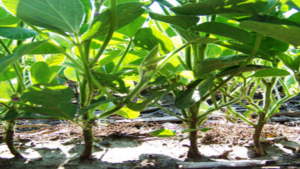 Row spacings less than 30” also show a consistent positive yield response. I like 15” to 20” rows for several reasons. First, you get an earlier canopy than 30” rows, which helps with weed control and increases photosynthetic efficiency. Second, a 15” or 20” soybean planter is usually made up of planter row units, instead of an air or box drill on narrower rows. Planter row units have much more consistent spacing, depth, and down pressure control than a drill can achieve, and this will help with emergence uniformity.
Soybeans definitely have the ability to compensate for lower plant populations, and research will show that yields do not start to fall off until we get below 80,000 plants per acre. We do tend to see a little bit of a positive correlation to higher populations at high-yield levels though. When we are also looking at early planting dates, we want to increase the planted population as well. I like to shoot for a final plant stand of at least 110,000, and a planted population of 140-160,000.
- Pest Control
Keeping soybean fields weed-free from Emergence to Harvest will help to maximize yield potential. This will require scouting to understand the weed spectrum present and then using multiple herbicide MOA (modes of action) for the best control and to delay weed resistance. One way to use a novel MOA for soybeans is with our new Roundup Ready 2 Xtend® soybeans, which are tolerant to the dicamba herbicide. Adding an approved dicamba herbicide can help control resistant weeds and provide up to two weeks of residual control, as well.
Soybean seed treatments will help manage seedling diseases and insect pests and help maintain a good stand. Late-season fungicide and insecticide treatments during R3 (beginning pod) usually show a consistent positive yield response, especially in high yield environments.
While the production practices of the record soybean-yield growers may not be applicable to much of the western corn belt, their attention to detail and desire for continuous improvement can be put to use anywhere. The practical management considerations outlined above are likely to produce the greatest return on investment that we can make. If you’d like to talk more about this, or have any other management questions, contact your local DSM to get in touch with a sales agronomist in your area.